
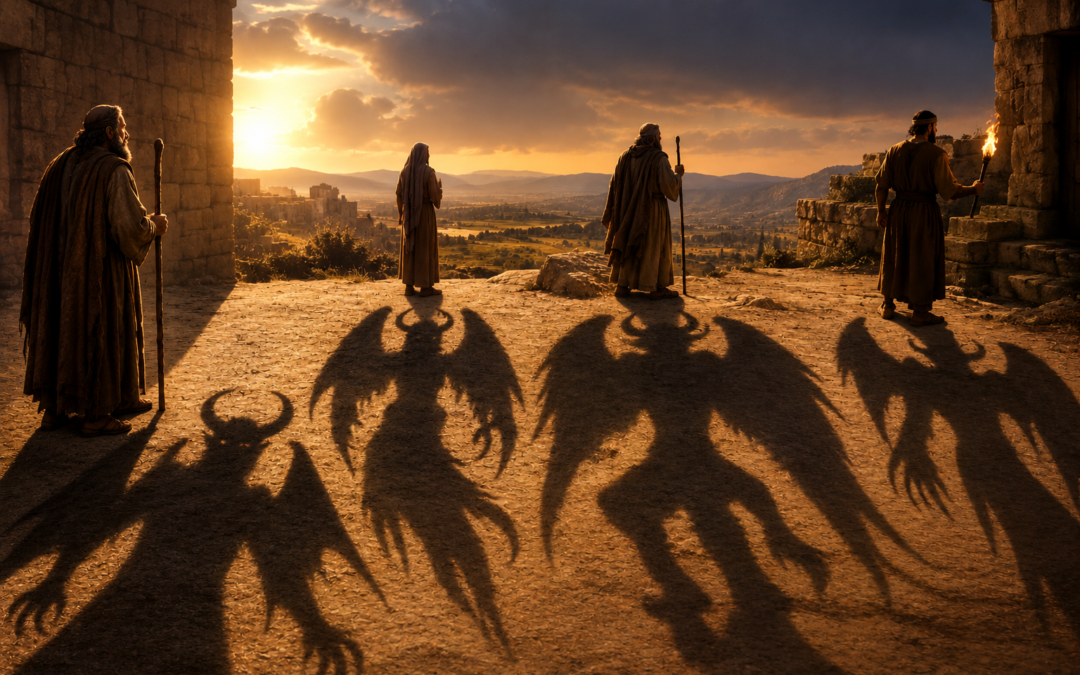
In Genesis 6:1-4, we read that the sons of God married daughters of men. The offspring were called Nephilim and were mighty men. In part one of this series, we looked at other biblical texts to discern who the sons of God are. We found that throughout the Old and New Testaments, God refers to His people as sons, and they refer to Him as Father. Believers, not angels, have been adopted into God’s family of sons.
In part two, we investigated the claim that the “sons of God” in Genesis 6:1-4 were fallen angels who married human women and produced gigantic offspring. However, this view cannot be exegeted from the text. Scripture never identifies angels as “sons of God,” and there is only one location in poetic literature where that could even be reasonably inferred. Furthermore, the author of Hebrews presupposes that angels do not have the title “sons of God” as believers do and as Christ does (Hebrews 1:4-5). We discussed numerous theological problems with the fallen angel view that put it at odds with Scripture.
Nevertheless, the fallen angel view was common in the centuries surrounding Christ’s earthly ministry. Many Jews and even early Christians held that view. But if this view doesn’t come from the Scriptures, where did it originate? Why did it become popular in the early church, then nearly completely rejected for the majority of church history, only to be revived again very recently? It is probably not possible to answer these questions definitively since we cannot travel back in time and interview the earliest advocates. But historical documents do shed light on this issue.
Historical Context
Genesis was written by Moses, likely during the forty-year sojourn of the Israelites as they departed from Egypt. One conservative estimate puts this at around 1446 to 1406 B.C. For the next thousand years, there is no evidence that anyone interpreted the “sons of God” in Genesis 6:1-4 as fallen angels. However, many Scriptures confirm that the Israelites during this time considered themselves as the sons of God (e.g., Deuteronomy 14:1; 32:6; Exodus 4:22-23; Isaiah 63:16; 64:8; Jeremiah 3:4, 14, 19, 22; 31:9; Hosea 1:10; Malachi 1:6; 2:10). They understood that believers were God’s sons. We begin to see evidence that some people held the fallen angel view roughly two centuries before Christ’s earthly ministry. Historically, the fallen angel view seems to have developed during the time of the Greek Empire. Could this provide a clue?
By 323 B.C., Alexander the Great had conquered much of the civilized world, forming the Greek Empire. Greek culture heavily influenced the world, and Greek became the international language. Even after the fall of the Empire, Greek philosophy, culture, and language continued to influence the world – including the early church.
Greek mythology became known to the world during the time of the Empire. The ancient Greeks were polytheistic – believing in many gods. However, the Greek conception of their gods is very different from the biblical God. Greek gods were not all-powerful, all-knowing, or omnipresent. They were not eternally existent but had a beginning in time. They were not fundamentally spirit but had corporeal bodies. They were gendered – they came in male and female versions – and they reproduced sexually. About the only thing the Greek gods had in common with the biblical God is that they were immortal. This is what distinguished them from human beings. In Greek thinking, human beings were always mortal, unlike the gods that were immortal.
Different gods were thought to control different aspects of nature. Poseidon was thought to control the sea, along with earthquakes and floods. Demeter was the goddess of agriculture and the harvest. Artemis was the goddess of the hunt and of the moon.[1] Zeus became king of the gods after overthrowing his own father Cronos. So the Greek gods and goddesses were essentially immortal and very powerful versions of human beings. And they had human desires and weaknesses. As such, they sometimes mated with humans and produced offspring that were essentially a god-human hybrid – a demigod.
As one example, you may have heard of the myth of Heracles (known as Hercules in Roman mythology). The story goes that Zeus desired the human woman Alcmene. He slept with her by disguising himself as her husband, Amphitryon. The offspring of this was Heracles, who grew to become a mighty man with supernatural strength. This is a common theme in Greek mythology. Indeed, there are many similar Greek myths of gods producing demigod offspring with human women. Divine beings sleep with human women, and the offspring become mighty men of old, men of renown. Does this sound familiar? It would be very tempting for Jews of the time period to start thinking of angels as “little gods” and read this kind of mythic interpretation into Genesis 6:1-4.
Jewish Literature
In any case, the timing fits. Within a century of the formation of the Greek Empire, we begin to see the first instances of Jews interpreting the sons of God in Genesis 6 as fallen angels who mated with human women. These are found in the Book of Enoch, the Book of Jubilees, and the Damascus Document.
There are three books attributed to Enoch. It is the first of these (1 Enoch) that contains the story of angels marrying humans and producing giant offspring who were 450 feet tall. This book was written in stages. The oldest section includes the text relevant to our discussion and is estimated to have been written either in the third or second century B.C. Of course, the biblical Enoch lived over two thousand years earlier. So this book was certainly not written by him.
It was common in the centuries both before and after Christ’s earthly ministry for people to write a document and ascribe a false author – a biblical figure – to give the work credibility. These works are called the pseudepigrapha – the false writings. They include such forgeries as the Gospel of Thomas, the Gospel of Peter, the Apocalypse of Abraham, and of course the three books of Enoch.[2]
The Book of Jubilees was written in the second century B.C. It proports to give additional information about the early history of the world up to the time of Moses at Mount Sinai. However, there is no reason to believe that such extra details are historical since they were invented more than a thousand years after the events took place. In other words, unlike the Scriptures that were written primarily by eyewitnesses and also under the inspiration of God, the Book of Jubilees is neither. However, like 1 Enoch, the Book of Jubilees proposes that the “sons of God” in Genesis 6:1-4 were angels who interbred with human women.
The Damascus Document is a Hebrew text that outlines the theology and customs of a particular sect of Jews known as the Essenes who lived in the Qumran region. It dates to the second or first century B.C. There were four primary sects of Judaism in the first century. Scripture mentions the Pharisees, Sadducees, and Zealots (e.g., Matthew 3:7; 10:4). The first century historian Josephus confirms these three and also mentions the Essenes. Much of what we know about the Essenes comes from the Damascus Document. The Damascus Document interprets the sons of God in Genesis 6:1-4 as fallen angels who mated with human women and produced gigantic offspring – the size of cedar trees!
A Hermeneutical Question
The fact that many Jews (and early Christians) interpreted the sons of God in Genesis 6:1-4 as fallen angels is historically well established. What Christians debate today is whether that fact should guide our interpretation of Genesis 6. The answer to this question will largely determine a person’s view on Genesis 6:1-4.
Since there is no text of Scripture that explicitly teaches that angels are sons of God, that position cannot be exegeted from the text itself, as we saw in the previous two articles.[3] Yet, many Jews in the time of Christ’s earthly ministry did interpret the text that way. Is it appropriate to use outside texts and philosophies to guide our interpretation of Scripture? In other words, is eisegesis (reading into the text based on outside ideas) sometimes acceptable? Or do we stick to pure exegesis and let Scripture alone interpret Scripture?
We do embrace the grammatical historical approach to the interpretation of God’s Word. This involves looking at the grammar and history of the time period to give insights that might help us understand the biblical text. Thus, external literature can give us insight into words, phrases, idioms, and customs of the time period. For example, the corban rule is mentioned only briefly in Scripture (Matthew 15:3-6; Mark 7:9-13). And scholars gained increased understanding of it by consulting non-biblical Jewish literature. However, (1) the literature was from the same time period as the Scriptural references, (2) scholars did not assume that the Bible was endorsing the custom, and (3) it did not override the clear meaning of the text. That is appropriate. The common error is in assuming that the Bible is necessarily affirming the common opinions of the time.
For example, Christian evolutionists and old-earth creationists favor using outside information to interpret Genesis. They say we must use our modern “knowledge” that the Earth is billions of years old to interpret the days of Genesis as vast ages, or to interpret the creation events as symbolic for evolution. They read the text in light of our modern traditions, just as the Jews at the time of Christ read the text in light of their traditions.
But Jesus strongly rebuked such attitudes. He said, “You invalidated the word of God for the sake of your tradition” (Matthew 15:6b). Jesus said that we are to live “on every word that proceeds out of the mouth of God” (Matthew 4:4b). It seems that we should confine our interpretation of Scripture to Scripture itself and avoid the temptation to read into the text based on outside philosophies or non-biblical texts.
Would it be appropriate to read into an early text (like Genesis 6:1-4) ideas that developed over a thousand years later? During Christ’s earthly ministry, the Sadducees had developed the belief that there was no resurrection (Matthew 22:23; Mark 12:18; Acts 23:8). Jesus didn’t use their ideas to interpret the Scriptures; rather, He refuted them from the Scriptures (Matthew 22:23-34). Likewise, Jesus refuted the unbiblical traditions of the Pharisees from Scripture (Matthew 15:2-9). There is no record of Jesus encountering the Essenes or their beliefs about fallen angels. But wouldn’t He have done the same with them?
It has become fashionable lately to attempt to read into Scripture based on cosmology or mythology of other ancient Near Eastern (ANE) cultures. We are told that the Bible must teach that the Earth is a flat disk covered by a solid dome since other cultures at the time believed this. But this doesn’t follow logically. God rebuked the Israelites for following the traditions and practices of their pagan neighbors (e.g., Deuteronomy 12:30-31). The Bible gives us truth in contrast to the myths and speculations of the surrounding nations of the time. Extra-biblical literature does indeed reveal what many people believed at the time and can give insights into language and customs. But we cannot assume that the biblical authors embraced such customs. Therefore, if we are to understand the intention of God in Scripture, we must interpret Scripture in light of Scripture.
Furthermore, advocates of reading the Bible in light of non-biblical literature like 1 Enoch are very selective and inconsistent in their approach. For example, 1 Enoch teaches that the Nephilim were giants whose height was 300 cubits – about 450 feet! The Greek and Aramaic traditions claim the giants were 3000 cubits tall! Likewise, the Damascus Document describes these giants as being as tall as cedar trees with bodies like mountains. Clearly this was the common belief among advocates of the fallen angel position at the time. Few Christians today would accept such details, yet many are comfortable reading other details of these texts into Scripture – an inconsistency known as cherry picking.
The Early Church
Could Christians in the time shortly after Christ’s earthly ministry have been influenced by Jewish writings like the Book of Enoch? We know that early Christians were aware of this book and read it, although neither they nor the Jews of the time believed it to be inspired by God.[4] However, they might have believed it was basically true. There were other non-biblical books like The Jewish War by Josephus or 1 Maccabees that Christians often read and accepted as (mostly) historically accurate even though they are not inspired by God. Could this be why some early Christian writers like Justin Martyr or Irenaeus of Lyons thought that the sons of God in Genesis 6 were fallen angels?[5] And should such beliefs be taken as evidence of the truthfulness of that position?
There may be another reason why that view was popular early but discarded later: the Septuagint. The Septuagint is the earliest Greek translation of the Old Testament. This translation project began as early as 250 B.C., and (the first version) was completed by the first century B.C. This was, of course, the same period of time when we see the first documents interpreting the sons of God in Genesis 6:1-4 as fallen angels. No doubt this common view influenced some of the translators or copyists of the Septuagint. We know this because some ancient copies of the Septuagint actually have the phrase “angels of God” (in Greek) in Genesis 6:2 instead of “sons of God.”
To be clear, there is not simply one Septuagint. There are many ancient copies of the Septuagint, and they have minor differences between them. Many copies of the Septuagint correctly translate the Hebrew phrase “sons of God” into the equivalent Greek phrase “sons of God.”[6] But some copies have replaced that literal translation with their interpretation, and rendered the phrase as “angels of God.”[7],[8] One example is Codex Alexandrinus, an early fifth-century manuscript still in existence today. And the Septuagint normally translated the Hebrew word “Nephilim” into the Greek word meaning “giants.”
Most Christians of the early church could not read Hebrew but could read Greek. Therefore, the Septuagint was the Old Testament used by the early church almost exclusively. They used the Septuagint for the same reason that most of us use an English translation. It was what they could read. And we have just seen that many early Septuagint copies rendered the “sons of God” in Genesis 6:1-4 as “angels of God.” It seems very likely that many early Christian writers apparently believed that angels of God married women because the only Bible they could read literally said as much. They had no way of knowing that this was an interpretation and not a literal translation of the Hebrew text.
Origen and the Hexapla
But there is one very early Christian writer who apparently rejected the fallen angel view of Genesis 6: Origen (A.D. 185 – 253). He taught that neither God nor the angels did the kinds of things attributed to the Greek gods.[9] At first, this is quite surprising because Origen often allegorized the early chapters of Genesis. We might think that he would be the first to defend a view compatible with Jewish mythology contained in books like 1 Enoch. Why did Origen take a more literal and natural view?
What did Origen know that nearly all early church fathers did not know? The answer is Hebrew. Origen could read Hebrew, but nearly all other early church fathers could not and relied exclusively on the Septuagint. Origen knew that the original Hebrew text of Genesis 6:1-4 said nothing about angels. He knew that “angels of God” was an interpretation found in many copies of the Septuagint. In fact, Origen knew a great deal about manuscript evidence and produced a massive scholarly work on the topic known as the Hexapla.
The Hexapla compared various manuscripts of the Bible at the time. It did so in six columns for the Old Testament. The first column contained the Hebrew text, and the second column had the phonetic transliteration of that text in Greek letters. The remaining four columns had four different Greek translations of the Hebrew text. These included the Septuagint, and “the three” – three independent Greek translations by Aquila, Symmachus, and Theodotion, respectively.
Origen noted that the Septuagint rendered Genesis 6:2 as “sons of God” but that some versions had “angels of God” instead. The Greek translation of Aquila agrees that these are “sons of God,” and so does that of Theodotion.[10] Symmachus rendered the phrase “sons of the rulers,” indicating that he thought they were humans but noble or possibly judges.
Interestingly, Aquila translated the word “Nephilim” as “those who fall upon [others],” perhaps suggesting that these mighty men were warriors – not giants.[11] Similarly, Symmachus translated “Nephilim” into a Greek term meaning “the violent ones.” Theodotion maintained the Septuagint’s questionable translation of the term as “giants.”
Jerome and the Vulgate
By the end of the fourth century, the dominant language of the Roman Empire had shifted from Greek to Latin. Consequently, the Bible had been translated into Latin so that common people could read it. The New Testament was originally written in Greek, and so it was translated directly into Latin. But since most early Christians could not read Hebrew, the early Latin translations of the Old Testament were from the Septuagint, not the original Hebrew. These early Latin translations are collectively referred to as the Vetus Latina. Since they are based on copies of the Septuagint, some of them render the phrase in Genesis 6:2 as “sons of God,” whereas others render it as “angels of God.”
In A.D. 382, Pope Damasus I commissioned the scholar Jerome to produce a new, revised Latin translation of the Gospels. Jerome did not only this but ended up translating the entire Bible into what we now call the Vulgate, which was completed in A.D. 405.[12] Like Origen, Jerome was a Hebrew scholar. He correctly translated the term “sons of God” in Genesis 6:2 into Latin.
Once Christians had an accurate translation of Genesis 6:1-4 in their native Latin, the fallen angel interpretation essentially vanished. Likewise, many essential Christian doctrines had become solidified around this time, such as the Trinity and the eternality of the Son.[13] With accurate translations of God’s Word becoming increasingly available, Christians developed a more biblical theology regarding angels.
A Modern Resurgence?
Within the last few decades, there seems to have been a modern resurgence of the fallen angel interpretation of Genesis 6. Several factors may have contributed to this shift. First, there has been increased interest in apocryphal and pseudepigraphal books like 1 Enoch, and increased access to them via the internet. Early Christians knew about such books. However, these works are being promoted as if they have been rediscovered from ancient early Christians who wanted to hide them. Perhaps you have heard claims about the so-called “lost books of the Bible.” Works of fiction like The Da Vinci Code have given people false ideas about the canon of Scripture. And this leads to questions about whether these additional books should be accepted as Scripture or at least as historically accurate.
Second, there has been a push in academia to interpret the Bible in light of ancient Near Eastern ANE) mythology. Works like those of the late Michael Heiser, expressing his opinions on the “divine council,” have given people new ways to read Scripture – ways that the biblical authors never intended. God did not intend His Word to be interpreted in light of the pagan philosophies of the surrounding nations. Rather, His Word refutes those philosophies.
Conclusions
I suggest that Christians disagree on our conclusions on this issue because we start with different hermeneutical presuppositions.[14] When we have different approaches on how to read the Scriptures, we undoubtedly will come to different conclusions. Hopefully this short series has caused readers to consciously reflect on how we should attempt to understand God’s Word.
It is very easy to read our preconceptions into Scripture.[15] We all do it. It is part of our fallen nature. But God gave us His Word as well as brothers and sisters in Christ to help us understand it. We should help others see their blind spots, and we should be grateful when others help us see our own blind spots. Iron sharpening iron is biblical (Proverbs 27:17).
I want to remind readers that this is not a first-tier or even a second-tier issue. We should not have animosity over four verses dealing with a non-essential issue. I have good Christian friends who disagree with me on this issue, and we get along very well. But since the relevant text is in Genesis (a book that I specialize in defending), and since I am often asked about this issue, I have offered my reasoning on the topic and relevant verses to consider. I hope that they stimulate thinking, research, and an increased desire to read and study God’s Word.
[1] Greek mythology has influence even in our time. Artemis is the name of NASA’s current manned missions to the moon, just as Apollo was the name of the missions in the late 1960s and early 1970s.
[2] Some people might ask, “But doesn’t Jude quote from the Book of Enoch in verse 14? Doesn’t that mean that the Book of Enoch is accurate?” First, when the Bible quotes another book, it doesn’t mean that the other book is necessarily accurate throughout. Second, Jude is probably not quoting from the Book of Enoch – the exact wording differs. Rather, both Jude and 1 Enoch quote an actual prophecy of Enoch. Whether this prophecy had been written down somewhere or passed down by word of mouth, we do not know. But such a quote does not authenticate the Book of Enoch as accurate in general. On the contrary, Enoch’s genuine prophecy may have been included in the pseudepigraphal book of 1 Enoch to give it a sense of authenticity, just as some of Christ’s sayings are included in the false Gospel of Thomas.
[3] We showed previously that Hebrews 1:5 in context only makes sense if angels are never called “sons of God.” The term is reserved for Christ and His adopted brothers.
[4] Today, only members of the Ethiopian Church believe the book of 1 Enoch to be inspired by God. They also accept many other non-biblical books as Scripture. Such acceptance apparently began around the 4th century.
[5] In chapters 11 and 12 of Tim Chaffey’s book Fallen, the author documents early Christian writers who held various positions on the “sons of God” in Genesis 6. Chaffey holds to the fallen angel position. However, that position is very problematic as shown in the previous article.
[6] These include Codex Coislinianus (M) and the translations of Aquila and Theodotion.
[7] This is also the case with Job 1:6, 2:1, and 38:7.
[8] All translation involves at least some interpretation. This is because different languages have different ways of expressing certain ideas. This is why various English translations of the Bible differ slightly in their wording. Translators who employ the practice of formal equivalency try to interpret as literally word-for-word as possible, sometimes resulting in awkward wording in the target language. Translators who employ dynamic equivalency try to convey the basic idea in the target language regardless of exact wording, resulting in a more readable text that is more susceptible to the biases of the translator. There is no prefect solution.
[9] Origen, Contra Celsus, I.17
[10] Aquila also rendered the word for “God” in the plural (“gods”) as it is in the Hebrew language.
[11] Recall that the Hebrew word Nephilim is similar to the Hebrew term naphal – meaning “he fell.”
[12] Vulgate means “common.” It was a translation that the common person could read in his native Latin without having to learn Greek or Hebrew.
[13] Some Christians have the mistaken impression that Christians of the first three centuries had the best, most biblical theology, only for that theology to degrade in the subsequent centuries. In reality, nearly every Christian doctrine was disputed and debated in those early centuries. For example, there was the Arian resurgence in the middle of the fourth century during which the majority position was that God the Son had not always existed! Paul’s own letter to the Galatians shows just how bad theology was in the church of the first century. Keep in mind that the Bible was not as readily available then as it is now. Justin Martyr, for example, may not have had access to Paul’s epistles, as he never mentioned Paul.
[14] To what extent, if any, should outside books like 1 Enoch influence our understanding of the text? Can we use New Testament information to better understand an Old Testament text or phrase? Should the early church writers influence our thinking on these issues? Is the term “sons of God” synonymous with phrases like “children of God” or “sons of the Most High”? These are just a few hermeneutical questions to consider.
[15] I have seen some advocates of the fallen angel view say things like, “Of course they were angels! The Bible says that sons of God are angels in passages like Job 2:1 and Genesis 6:2.” No, the text doesn’t say that; the word “angel” is not even mentioned in these passages. Such advocates don’t even realize that they are reading into the text something that isn’t there.