
Who Were the Nephilim? Part 1
There is an intriguing account in Genesis 6:1-4 of “sons of God” marrying “daughters of men” and having children called Nephilim who became “mighty men” of renown. This event took place shortly before the global Flood. Some English versions translate the word Nephilim as “giants.” Who were these mighty men? And who were the sons of God? These four little verses have resulted in a lot of controversy. And Christians continue to debate what they mean. Can we discover the identity of the sons of God and the Nephilim?
Before we delve into these issues, I must point out that this topic is not a first-tier or even a second-tier issue. There is nothing essential to the theology of salvation regarding the identity of the characters in this account. Thus, Christians can disagree on these issues while still agreeing on the essentials of the faith. Nonetheless, I believe we can discover what Moses intended to convey in these verses through careful reasoning starting with Scripture. And so, this is a study in hermeneutics – how to properly interpret Scripture.
Three Common Positions
In the spirit of a multiple-choice exam, I will give three possible answers to this question at the outset. Of course, it is possible that none of these are correct. But these are positions that have been held by Christians at various times.
First, some Christians have argued that the “sons of God” are believers. The implication is that the daughters of men were unbelievers. These unequally yoked marriages resulted in children who fell away from faith in the Living God. In this view, the Nephilim were probably not giants at all, but ordinary people who rejected the faith of their fathers due to their unbelieving mothers.
As a sub-category of this position, some Christians believe that the believing sons of God were descended from Seth, the son of Adam, and that the unbelieving daughters of men were descended from Cain – the first murderer. The idea is that the descendants of Seth were generally believers, whereas the descendants of Cain were not. This undoubtedly has been the most common position throughout the history of the church.
Second, some people have claimed that the “sons of God” were men of power, perhaps tyrants. The implication is that they took for themselves the daughters of men (common women) and produced children. As with the former view, these children would be fully human, and probably not giants.
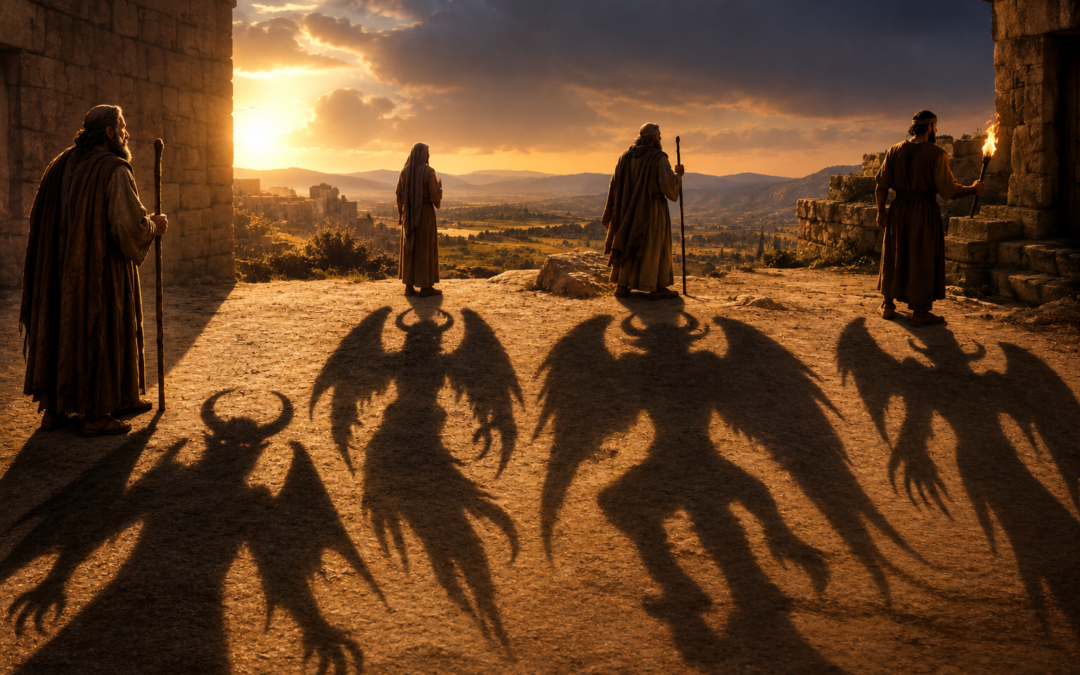
Third, some people have proposed that the “sons of God” were fallen angels who lusted after women (the “daughters of men”) and married them. The offspring would possibly be an angel-human hybrid, resulting in giants. Advocates of this position sometimes further postulate that this extraordinary evil was the reason God sent the global Flood – to destroy these abominations.
Hermeneutics
The view people end up with is heavily influenced by their theory of hermeneutics – the principles of interpreting Scripture. There are many principles of hermeneutics, and I have written a book on them called Understanding Genesis. First and foremost, we must decide whether we are going to let the biblical text determine our conclusions (exegesis) or whether we will let philosophies and ideas outside the text decide what the text means (eisegesis).
Exegesis refers to extracting out of the text what God has placed in it. Eisegesis is reading into the text something the author never intended. If our goal is to understand what the author intended, then exegesis is the method we must use. Those who practice eisegesis have no reason to even read the text in the first place since their understanding of it is merely a reflection of the ideas they already have. Therefore, if we are going to be faithful Christians, we must strive to do exegesis. And this involves putting aside our own preferences and philosophies and allowing the text to determine the meaning of the text.
Of course, there are ultimately two authors for most of Scripture: the human author who put ink on the page and God who inspired the author to do so (2 Timothy 3:16; 2 Peter 1:21).[1] Since God is ultimately the Author of all Scripture, and since He never contradicts Himself, we can and should use the rest of Scripture to help us interpret any given passage. In light of this, we now ask the question: who were the “sons of God”?
The Sons of God
Genesis 6:1-4 does not give a lot of details on who the sons of God were. But the rest of Scripture does. The term “sons of God” is found ten times in the NASB95 translation,[2] and the similar phrase “children of God” is found eleven times.[3] Other variations also exist, such as “sons of the living God”[4] or “sons and daughters to Me.”[5] What do these terms mean?
There is of course the Son of God (singular), which refers to Christ – the second Person of the Trinity who is God Himself (e.g., Mark 1:1; John 11:27). He is the only begotten Son of God (John 3:16; 1 John 4:9). As such, He is the only Son of God who shares the Father’s nature as God.
But what does the plural term “sons of God” mean? A survey of Scripture shows that this phrase (and similar phrases like “children of God”) nearly always refers to believers – those who have trusted in Christ for salvation. For example, in Galatians 3:26 Paul says of believers, “For you are all sons of God through faith in Christ Jesus.”
Notice that Paul does not say, “You will be sons of God” or “you are becoming sons of God.” No. Believers are currently sons of God. Although we will experience the fullness of our inheritance in the eternal state, we are already sons of God. Those who have repented of sin and trusted in Christ for salvation have been adopted in God’s family as sons. Romans 8:14 states, “For all who are being led by the Spirit of God, these are sons of God.”
As such, God addresses believers as sons. Hebrews 12:5 states, “And you have forgotten the exhortation which is addressed to you as sons, ‘My son, do not regard lightly the discipline of the Lord, nor faint when you are reproved by Him.’” And God disciplines those believers He receives as sons. Hebrews 12:7 states, “It is for discipline that you endure; God deals with you as with sons; for what son is there whom his father does not discipline?”
Sometimes the term “children” is used instead of “sons.” Romans 8:16 states, “The Spirit Himself testifies with our spirit that we are children of God.” But how can physical finite creatures like ourselves be considered children of God when God is a spirit and has only one begotten Son? The answer is that all God’s other children have been adopted. In Ephesians 1:5, Paul states, “He predestined us to adoption as sons through Jesus Christ to Himself, according to the kind intention of His will.” Galatians 4:5 states, “So that He might redeem those who were under the Law, that we might receive the adoption as sons.”
Thus, Jesus Christ considers Christians as His brothers. Hebrews 2:11-12 states, “For both He who sanctifies and those who are sanctified are all from one Father; for which reason He is not ashamed to call them brethren, saying, ‘I will proclaim your name to My brethren, in the midst of the congregation I will sing your praise.’” So our part in God’s family has nothing to do with ethnicity or physical descent. Both Jews and Gentiles who have trusted in Christ are children of God. Romans 9:8 states, “That is, it is not the children of the flesh who are children of God, but the children of the promise are regarded as descendants.”
The believer’s status as a child of God is not merely a title; it is a fact. 1 John 3:1a states, “See how great a love the Father has bestowed on us, that we would be called children of God; and such we are.” 1 John 3:2a states, “Beloved, now we are children of God.” This honor belongs to all who believe in Christ for salvation. John 1:12 states, “But as many as received Him, to them He gave the right to become children of God, even to those who believe in His name.”
As adopted sons, we can refer to God as our Father. Romans 8:15b states, “You have received a spirit of adoption as sons by which we cry out, ‘Abba! Father!’” Indeed, Jesus taught us to pray, “Our Father who is in heaven” (Matthew 6:9).
But isn’t the believer’s position as a son of God just a New Testament doctrine? Not at all. In Deuteronomy 14:1a, the Lord says of His people, “You are the sons of the LORD your God.” Again, in Exodus 4:22 the Lord says, “Israel is My son, My firstborn.” Thus, Old Testament believers can say, “You, O Lord, are our Father” (Isaiah 63:16) and “But now, O Lord, You are our Father” (Isaiah 64:8).
In the Old Testament, the sons of God (believers) were mainly from the nation of Israel, which God selected from all the nations to be His chosen people (Deuteronomy 7:6). However, the Old Testament prophesied of a time when Gentiles would also be adopted as sons of God. Hosea 1:10 states, “Yet the number of the sons of Israel will be like the sand of the sea, which cannot be measured or numbered; and in the place where it is said to them, ‘You are not My people,’ it will be said to them, ‘You are the sons of the living God.’”
The fact that a believer is a child of God is theological important. This is because salvation cannot be earned (Galatians 2:16). Rather, it is inherited (Matthew 25:34; Hebrews 1:14). Only by being adopted into God’s family can we be saved (Galatians 4:5). So the term “sons/children of God” is a fitting title for believers – men and women who have received Christ as Savior. Although the title might be used nonliterally in places, its main meaning in Scripture refers to believers.[6] Therefore, unless there is compelling contextual evidence to the contrary, it is hermeneutically appropriate to understand the “sons of God” as believers. But there is more.
Men are Sons
In the Old Testament, there is an important aspect of theology that is sometimes lost in English translations. Namely, all men are descended from Adam and have inherited his sin nature. Just as believers inherit salvation by being God’s sons, the unregenerate man inherits Adam’s sin as part of his nature. Thus, the Old Testament emphasizes our need for salvation by reminding us that we are all descendants of Adam – that all men except Adam are sons. And it does so by using the term “son” in places that might seem awkward in English.
For example, in the NASB95 translation, Genesis 17:24 begins, “Now Abraham was ninety-nine years old…” But the Hebrew is more literally translated: “Now Abraham was a son of ninety-nine years…” (underline added). In fact, this is the normal way the Bible reports the age of a man (e.g., Genesis 5:32; 7:6; 12:4; 16:16; 21:5; 25:20; 26:34). Likewise, Job 1:3 records that Job was the “greatest of all the men of the east.” But the word translated “men” is literally “sons.” Job was the greatest of all the sons of the east. The Bible subtly reminds us that Job, like all of us, is a descendent of Adam.
When Saul recruited any “valiant man,” the Hebrew text actually uses the word “son” instead of man in 1 Samuel 14:52. The “worthless man” mentioned in 1 Samuel 25:17 is literally a worthless “son.” The valiant men of 2 Samuel 17:10 are literally “valiant sons” in Hebrew. And many other examples could be cited. Thus, in the Old Testament we infer that “sons of God” are “men of God” – descendants of Adam who trust in the Lord.
Application
When we start with Scripture and allow it to define its own terms, we learn that the term “sons of God” is normally a reference to believers – human beings who have trusted in God for salvation. This is exegesis. There may be non-literal usages of this phrase as well, but this is undoubtedly the main meaning. Therefore, unless there is compelling contextual evidence to the contrary, we expect this is the meaning of the term, particularly in sections of Scripture that are literal (such as historical narrative). This is an application of hermeneutics.
The context of Genesis 6:1-4 is historical narrative; it describes the conditions that led up to the events of Noah and the global Flood. Therefore, we conclude that the “sons of God” were believers in the Living God. The fact that they married “daughters of men” rather than “daughters of God” strongly suggests that these men married non-believing women. God does not condone this type of marriage because the husband and wife are “unequally yoked.” In 2 Corinthians 6:14, Paul says to believers, “Do not be bound together with unbelievers; for what partnership have righteousness and lawlessness, or what fellowship has light with darkness?”
God was also concerned about unequally yoked marriages in the Old Testament. He warned the Israelites not to intermarry with pagans of the surrounding nations. This had nothing to do with ethnicity. Rather, it was due to the unbelieving nature of the surrounding peoples. Deuteronomy 7:3-4 states, “Furthermore, you shall not intermarry with them; you shall not give your daughters to their sons, nor shall you take their daughters for your sons. For they will turn your sons away from following Me to serve other gods; then the anger of the LORD will be kindled against you and He will quickly destroy you.”
Genesis 6:1-4 is apparently a record of ancient believers violating God’s principle of being equally yoked.[7] The text says, “The sons of God saw that the daughters of men were beautiful” (Genesis 6:2a). The implication is that these believers were more concerned about physical beauty than godliness. Like Eve, they experienced lust and fell into sin. The result of unequally yoked marriages is that the children departed from the faith of their fathers. No doubt you have seen modern examples of this. Although there are some exceptions, ungodly parents tend to produce ungodly children.
Nephilim
Therefore, we deduce from Scripture that the Nephilim were the children of these unbiblical marriages between believers and non-believers. These children fell away from the faith of their fathers on account of their unbelieving mothers. This may actually be the meaning of the word “Nephilim.” The Hebrew word meaning “he fell” is naphal. In Hebrew, slight changes to the letters of a word can subtly adjust the meaning. For example, “light” in Hebrew is or, whereas “light bearers” is m’or. Likewise, “Nephilim” is likely related to a fall of some sort. I have read arguments against this position, but none that were compelling.[8]
Could Nephilim mean “giants”? Since there is no similarity between the word “Nephilim” and Hebrew words for stature (middah) or height (qowmah), this seems very unlikely. Perhaps the reason for such a belief is because some of the Nephilim after the global Flood were apparently giants. Let’s explore this.
The word Nephilim is used only three times in Scripture: in Genesis 6:4 and twice in Numbers 13:33. Numbers 13:17-33 is the report of the twelve spies that Moses had sent into the land of Canan. These spies reported that they saw Nephilim, the sons of Anak, and that they were giants. It is probable that Goliath was descended from these sons of Anak. But that doesn’t mean that the Nephilim of Genesis 6:4 were giants, nor that the word itself means “giants.” It only means that these particular examples of Nephilim were giants.
What the Nephilim of Numbers 13:33 and those of Genesis 6:4 have in common is that both groups had fallen away from faith in the living God. So again the possible meaning is that these were fallen ones. But we should be cautious about drawing conclusions about the meaning of a word that is used only three times in Scripture and whose meaning is not explicitly stated. In any case, there is no contextual reason to believe that the Nephilim of Genesis 6:1-4 were giants. The text only states that they were well known at the time before the Flood. The Bible describes them as “mighty men who were of old, men of renown.”
The Lord knew in advance what the result of such unbiblical marriages would be. It would lead to a generation of faithless men who do and think nothing but evil. The Lord specified that He would therefore destroy mankind in 120 years (Genesis 6:3). Some people misunderstand Genesis 6:3 as teaching that God was imposing a new limit on the maximum lifetime of man. After all, men once lived to more than 900 years, and now we don’t. But this interpretation is very unlikely. The lifespan of man did gradually decline after the Flood, but many people continued to live to very old ages for many generations long after God’s declaration of the 120 years. And reducing the lifespan makes no sense in terms of solving the problem. So the 120-year limit apparently marks the time until God would destroy mankind with the Flood – sparing only Noah and his family.
Context
Notice that this exegetical interpretation flows very naturally. Genesis 6:1-4 gives the background information leading up to the conditions in verse 5. Namely, the wickedness of man was very great on the earth such that “every intent of the thoughts of his heart was only evil continually.” But how did it get that way? How did we go from men calling upon the name of the Lord in Genesis 4:26 to men thinking and doing only evil continually? Genesis 6:1-4 gives the answer. Unbiblical marriages resulted in children who rejected the faith of their fathers and led to a generation that did not know the Lord.
Sethites and Cainites?
Many Christians historically have postulated that the “sons of God” were from the line of Seth, whereas the “daughters of men” were descended from Cain. There is some evidence that the line of Seth through Noah consisted of many believers. They tended to have God-honoring names such as Mahalalel, which means “praise of God” (Genesis 5:12-17). And there was Enoch who “walked with God” (Genesis 5:24) and Noah who found favor in the eyes of the Lord (Genesis 6:8). These were all descended from Seth. Conversely, the Bible gives an example from the line of Cain who was exceptionally wicked: Lamech (Genesis 4:19, 23-24).
So there is some merit to the belief that the descendants of Seth were godly believers and that the descendants of Cain were not. It could therefore be that the believers – the sons of God – were Sethites and that the unbelieving daughters of men were Cainites. However, this interpretation goes beyond the text. It is entirely possible that some descendants of Seth apostatized and that some descendants of Cain became believers over the hundreds of years before the Flood. Therefore, the most conservative and exegetical position is that the sons of God were believers and the daughters of men were unbelievers, regardless of their respective lineages.
Tyrants?
What then of the position that the sons of God were tyrants? This was never a very popular position, and I don’t believe it can be exegetically derived. But the reason for it may concern the flexibility of the Hebrew word translated as “God” in the Old Testament. The Hebrew term often translated “God” is elohim (אֱלֹהִ֑ים) and is perhaps most literally translated as “mighty ones.” So it is not actually God’s name, but rather a title that is often applied to God – the mightiest of the mighty. When this plural noun is used as the subject of a sentence that uses a verb in the singular form, it always clearly refers to God. The first verse of the Bible uses this construction: “In the beginning God(s) [plural] created [singular] the heavens and the earth” (Genesis 1:1). The fact that such sentences use a plural noun with a singular verb may be an indication of God’s triune nature. Namely, God is one in being, but three in Persons.
When the word elohim is used in other parts of a sentence, its meaning must be determined by context. Nonetheless, the term elohim usually means “God” in probably more than 90% of the Old Testament Scriptures. However, the term can also be used for false gods. Most of the remaining uses of elohim refer to false gods. For example, Exodus 12:12 states, “For I will go through the land of Egypt that night, and will strike down all the firstborn in the land of Egypt, both man and beast; and against all the gods [elohim] of Egypt I will execute judgments: I am the LORD.” There is a third usage that is quite rare. The term elohim can be used for those people who act on God’s behalf, such as judges or rulers. One example of this is found in Psalm 82:6.[9],[10]
So it is possible that the “sons of God” in Genesis 6:1-4 were sons of the mighty rulers/judges of the ancient world who married common women. There is nothing in Scripture or in the Hebrew language that precludes such a possibility. But there is also nothing that suggests it in the context of Genesis 6. Furthermore, this interpretation does not explain why the children of such marriages were called Nephilim nor why this apparently resulted in the wickedness that followed. This interpretation is neither exegetically derived, nor does it cause the text to flow as well as the previous interpretation.
Conclusions
The exegetical approach leads us to believe that the “sons of God” in Genesis 6 were believers because that is consistently how the term is used in the rest of Scripture. Apparently, the marriage of believers to unbelievers resulted in children that fell away from the faith and resulted in a generation of people who practiced only evil continually. The text of Genesis 6 flows very naturally under this interpretation. Nonetheless, some people have claimed that “sons of God” must refer to angels at times, particularly in the book of Job. We will examine this line of argumentation in the next article.
[1] The one exception is a section of Scripture beginning in Exodus 20, which was written solely by God without any human agent.
[2] Genesis 6:2, 4; Job 1:6; 2:1; 38:7; Matthew 5:9; Luke 20:36; Romans 8:14, 19; Galatians 3:26
[3] John 1:12; 11:52; Acts 17:29; Romans 8:16, 21; 9:8; Philippians 2:15; 1 John 3:1, 2, 10; 5:2
[4] Hosea 1:10; Romans 9:26
[5] 2 Corinthians 6:18
[6] In Acts 17:29, Paul seems to apply the term “children of God” in a non-literal way that may refer to all mankind rather than just believers. He had just quoted from Greek poetry and was perhaps using their own terminology as part of a reductio ad absurdum argument. Namely, if we are children of God, then how could gods be made of stone or silver – as with the idols?
[7] The retort that such a command had not yet been written down is no excuse. No commands were yet written as far as we know. Yet Cain still knew that it was wrong to murder Abel. God has written His law on our hearts so that we have innate knowledge of right and wrong (Romans 2:14-15).
[8] For example, I read an argument stating that the vowels for “fallen ones” would be different than those of “Nephilim.” However, the original text of Genesis had no written vowels. Vowels were added by the Masoretes over two thousand years after this text was written.
[9] I have read an argument that the elohim in Psalm 82:6 are actually angels. However, verse 7 would seem to refute this idea. Verse 7 indicates that these rulers will die like men, yet, according to Christ, angels do not die (Luke 20:36).
[10] Jesus quoted this verse John 10:34 to refute the religious leaders who had accused Him of blasphemy. However, many Christians today misunderstand Christ’s argument. He was using an a fortiori argument – arguing from the lesser to the greater. Namely, if it was appropriate to call those people who merely acted on God’s behalf “gods,” how much more fitting is it to call the only begotten Son “God” since He is God Himself?