
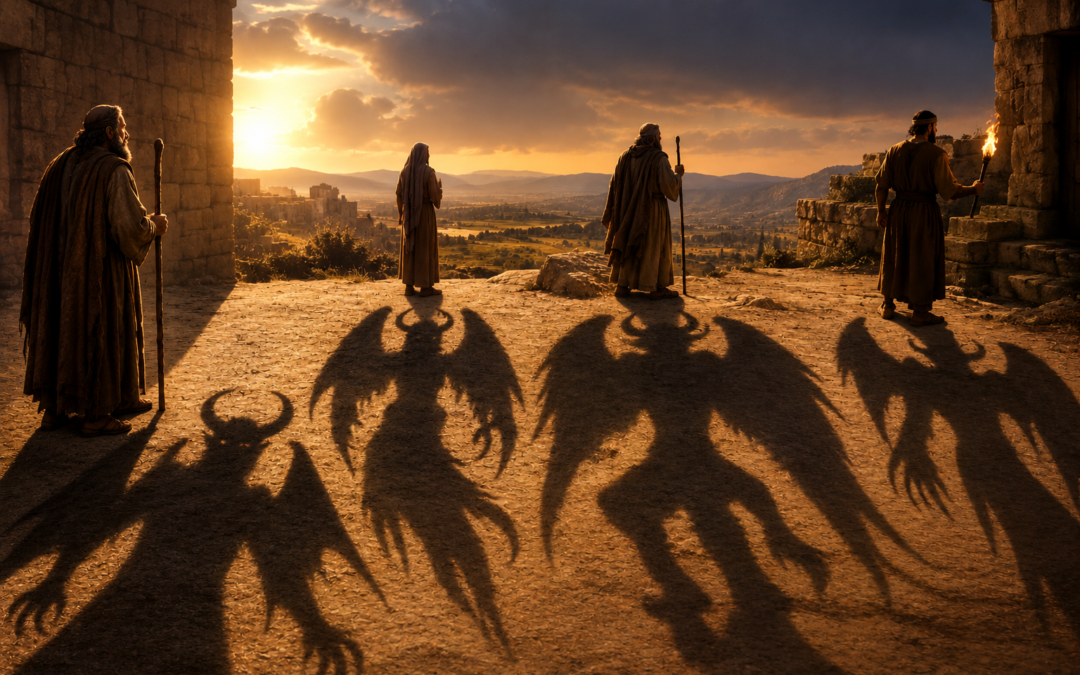
In Genesis 6:1-4, we read that the sons of God took wives from the daughters of men. The offspring were called Nephilim and became mighty men of renown. In the previous article, we searched the Scriptures to see what they say about the “sons of God” and found that this term almost always refers to believers: human beings who trust in God for salvation and have been adopted into His family (e.g., Deuteronomy 14:1; Galatians 3:23; Ephesians 1:5). Thus, we infer that the sons of God in Genesis 6:1-4 were believing men who married unbelieving women and whose children fell away from the faith. However, some people have suggested that the “sons of God” in Genesis 6:1-4 were fallen angels. Let us examine this view.
Job 1:6 and Job 2:1
Supporters of the fallen angel position often cite passages in Job for support. Namely, there are three verses in Job that refer to the “sons of God.” Could these refer to angels? The first two references are in Job 1:6 and 2:1. Job 1:6 states, “Now there was a day when the sons of God came to present themselves before the Lord, and Satan also came among them.” Job 2:1 reports a second occurrence and is nearly identical in wording. Notice that the word “angel” does not appear in either verse. Nor is there any identification given for the sons of God. Many people assume that these are angels perhaps because Satan also came, and we know that he is a fallen angel. Indeed, the majority of conservative commentaries take the view that this is a heavenly/spiritual convention of spiritual beings – angels. But that is an interpretation and is not something the text actually states. So caution is advised.
If not angels, who else could they be? From the previous article, we learned that the term “sons of God” normally refers to (human) believers. And that interpretation makes perfect sense of Job 1:6 and 2:1. Even in our time, every Sunday, believers come to present themselves before the Lord. And Satan comes too – to distract and disrupt. That doesn’t mean that believers are angels.
Previously we saw that the Old Testament often uses the term “sons” for “men.” Thus, Job was the greatest of the men (literally “sons”) of the East (Job 1:3). Only three verses later we read of sons of God gathering to worship the Almighty. Could these be men of God? That interpretation fits the context and is perfectly sensible. A nearly identical phrase is used in Job 2:1. So these passages may be referring to gatherings of believers to worship God, with Satan coming along to accuse.
Regardless, my point is that the text itself does not state or logically require that the “sons of God” refers to angels here. Those who assume that position are reading into the text, and they may not even realize they are doing that. As we saw in the previous article, the term “sons of God” or its various equivalents (“children of God,” “sons of the Most High”) is normally associated with believers. Therefore, exegetically, that should be our interpretation unless context demands otherwise. But there is one verse where the context may indeed suggest otherwise: Job 38:7.
Job 38:7
Let’s examine the context. During his temptation, Job wanted to have a conversation with God to plead his case. God graciously answered Job but began by asking a series of questions that Job could not answer (Job 38:1). The purpose was apparently to show that Job was intellectually unqualified to debate the Almighty (Job 38:2-3). It is in this context that God asks Job where he was when God laid the foundation of the earth (Job 38:4). He asks about the measurements of the earth and the details of its construction. Of course, Job couldn’t answer these questions. It is in this context of God asking Job where he was in the early days of the universe that we read in Job 38:7, “When the morning stars sang together and all the sons of God shouted for joy?”
Presumably, “sons of God” in this context cannot refer to believers since there were no humans early in the creation week, and there were only two humans by the close of day six. Although technically accurate, it would seem odd to refer to just Adam and Eve as “all the sons of God.” But to assume “therefore, it must be angels” is a bifurcation fallacy. Again, I must point out that the text doesn’t mention angels at all. Those who assume that sons of God are angels here are reading into the text something that is not present. (That doesn’t automatically make the interpretation wrong; it is simply the case that it cannot be read out of the text itself.)
This section of Job is highly poetic, and so we might expect non-literal imagery as is typical in poetry. Verse 7 uses the typical Hebrew poetic form known as synonymous parallelism. In this form, two (or more) statements convey the same basic idea using different words. As such, there is a parallel between the first part of verse 7: “the morning stars sang together” and the second part: “all the sons of God shouted for joy.” Just as “sang” and “shouted for joy” go together, “stars” and “sons of God” apparently refer to the same things, or at least similar things.
Stars are sometimes used to symbolize angels in Scripture (e.g., Revelation 12:3-4). This may be why many commentators indeed interpret the stars / sons of God in Job 38:7 as angels. But this is by no means conclusive. After all, stars can represent people in Scripture as well (Genesis 37:9-10; 15:5), or the nation of Israel (Revelation 12:1). And, of course, they can be literal stars as well (Genesis 1:16). Could the “sons of God” poetically refer to literal stars? God is called the “Father of lights” in James 1:17.
Someone might respond, “But stars are not conscious. Only conscious beings like angels can praise God.” That might be true in a literal sense, but Job 38:7 is highly poetic. Does the Bible depict non-conscious creations praising God in poetic literature? Of course – and stars in particular! Psalm 148:3 states, “Praise Him, sun and moon; praise Him, all stars of light!” The point here is not to conclusively identify the sons of God in this passage, but to point out that those who assume them to be angels are reading into the text something the text does not state.
But let us assume for the sake of argument that the “sons of God” in this poetic passage really are angels. After all, many conservative commentators take this position. Would that give us license to read that meaning into Genesis 6:1-4? Not at all. It would be a hermeneutical fallacy. If angels are non-literally referred to as sons of God in poetic literature like Job 38:7, it would not be appropriate to insert this meaning into a literal historical passage like Genesis 6:1-4. We interpret literal passages like Genesis 6:1-4 in light of other literal passages like Deuteronomy 14:1 or Galatians 3:26.
For example, the Hebrew word for “day” is sometimes used non-literally to mean a general period of time, not necessarily 24 hours in length. The “day of the Lord” is mentioned in poetic passages like Isaiah 13:6, 9 and Ezekiel 30:3 as a non-literal day. Should we then take that meaning and insert it into literal passages pertaining to the creation week, like Genesis 1? Clearly not. Genesis 1 uses the word “day” literally because it is historical narrative, not poetry. Likewise, neither should we take a poetic use of “sons of God” (whatever it refers to) and insert it into historical narrative passages like Genesis 6:1-4.
However, there is yet another reason to believe that angels are never literally referred to as “sons of God.” It is found in the book of Hebrews.
Angels Are Not Sons of God
The central theme of the book of Hebrews is the superiority of Christ over the Old Testament administration. The author of Hebrews builds his case systematically.[1] In the first two verses, he argues that Christ is superior to the Old Testament fathers and prophets. For the remainder of chapter 1 and all of chapter 2, he argues that Christ is superior to the angels. In chapter 3, he argues that Christ is superior to Moses, and so on. Our focus will be in verses 4 and 5 of chapter 1. Here the author argues that Christ is superior to the angels on the basis that He has a more excellent name than they do. But Christ has many names: Jesus, Emanuel, Savior, Yahweh, and so on. To which name does the verse refer? The answer is that Jesus, and not the angels, is the Son of God.
Hebrew 1:5 states, “For to which of the angels did He ever say, ‘You are my son, today I have begotten you’? And again, ‘I will be a Father to Him and He shall be a Son to Me’?” The implied answer to this rhetorical question is: “None. God never calls His angels sons. Only Christ and His adopted brothers have such a title.” Notice that the text is not trying to prove that angels are not sons of God. Rather, the text presupposes that angels are not sons of God. It takes that as a given and uses it to prove something else, namely, that Christ is superior to angels because He is a Son of God and they are not.
However, hypothetically, if angels are called “sons of God” in literal texts like Genesis 6:1-4, then the author of Hebrews made a bad argument. His rhetorical question could be answered, “Lots of times! Don’t you know that God calls angels His sons in Genesis 6:1-4?” But the ultimate Author of Hebrews (and the rest of the Scriptures) is the Holy Spirit – who cannot err in His argumentation. Therefore, we must accept that angels are never literally called “sons of God.”
Someone might respond, “Perhaps Hebrews 1:5 simply means that Christ is the only begotten Son of God. Angels are sons of God, just not begotten sons.” If Hebrews 1:5 only cited the first quotation, “You are my son, today I have begotten you,” then I might agree. This is a quote from Psalm 2:7 referring specifically to Christ. But the second quote says nothing about being begotten. In fact, it cannot mean “begotten” when we look at the source.
The quotation cited in Hebrews 1:5, “I will be a Father to Him and He shall be a Son to Me,” is from 2 Samuel 7:14. The immediate context in 2 Samuel is not actually Christ, but King David (2 Samuel 7:4-5). That is, it was to David that God said, “I will be a father to him and he will be a son to Me.” Therefore, the text cannot mean “begotten son” because David was not a begotten son of God. Rather, he was an adopted son, just like all believers (John 1:12; 1 John 3:1-2).
Is the author of Hebrews misapplying this verse in claiming it applies to Christ? Not at all. It applies to Christ too since He is a Son of David (e.g., Matthew 9:27; 15:22; 21:9). The implication of Hebrews 1:5 quoting 2 Samuel 7:14 is that God is a father to both David and Christ, and they are both sons of God. Angels are not. Believers and Christ Himself have a relationship to God as a Father and thus share the title “sons of God” – a title that angels do not have.
Angels Are Not Sons at All
It should be obvious that angels could never literally be called sons of God because angels are not sons at all. They are created beings. I will grant that a created item might figuratively be called a son of God in poetic sections of Scripture since it is a creation of His.[2] But angels do not reproduce and are therefore not literally sons at all.
However, all men besides Adam are sons and have inherited His sin nature (Romans 5:12). That’s the bad news. The good news is that God the Son Himself took on human nature by being born as a descendant of Eve (Genesis 3:15; Luke 1:31-35). Thus, we are also related to Christ. This is why Christ is able to pay for our sins – He is our blood relative. According to God’s Law, only a blood relative may redeem someone (Leviticus 25:48-49; Galatians 4:4-5).
It is because angels are not sons that they are ineligible for salvation. They have no kinsman-redeemer because they have no kinsmen. Of course, the righteous angels have no need of salvation, and fallen ones have no desire for it. Christ made propitiation for the sins of the people – not the angels (Hebrews 2:16-17). And this is possible because men are sons. Angels are not. Therefore, we would not expect angels to have such a title in the literal, historical sections of Scripture, such as Genesis 6:1-4.
The Nature of Angels
Terminology aside, the problems with the fallen-angel view of Genesis 6 are legion.[3] Many of these may stem from a misunderstanding of the nature of angels and of their abilities. I am concerned that many Christians have an unbiblical view of angels. It seems increasingly common to think of angels as “little gods,” almost as if God reproduced finite versions of Himself, in His image, and perhaps with some degree of divine power. Perhaps this is why some people think that “sons of God” might be a fitting title. But this simply isn’t biblical. Such ideas can be read into the text but not exegeted out of it. According to the Bible, what are angels?
The term “angel” literally means “messenger.”[4] Such a title can be used of a human messenger (for example, 1 Kings 19:2 and Matthew 11:10 both use the same word as “angel” in their original respective languages). The term is also applied biblically on occasion to the Son of God when He delivered a message to a person. That is, sometimes the “Angel of the Lord” is the Lord Himself (Genesis 22:15-16). He is the one and only uncreated angel who is God.
But the term “angel” is most often used of spiritual beings that God created for the purpose of serving believers. According to Hebrews 1:14, angels are “ministering spirits, sent out to render service for the sake of those who will inherit salvation.” So God created them for us – not the reverse. As messengers, they were involved in the transmission of God’s Word to man (Hebrews 2:2). They sometimes give a specific message to a specific person (e.g., Luke 1:11-20, 26-38). In the Bible, angels are never said to be made in God’s image, nor we in theirs.[5] They were all created by God at some point during the creation week (Psalm 148:2, 5; Colossians 1:16; Exodus 20:11). About one third of them rebelled against God and fell with Satan (Revelation 12:4; Jude 1:6). This must have happened very shortly after the creation week and before the fall of Eve.[6] A fallen angel is usually referred to in Scripture as an evil spirit (Acts 19:16), unclean spirit (Matthew 12:43), demon (Matthew 17:18), or an angel of the devil (Matthew 25:41).
A spirit is a nonmaterial intelligence; it is not made up of atoms that have a specific location in space. God is a spirit (John 4:24). Humans have a spirit and also a material body (James 2:26). At death, the spirit of a believer is absent from the body but present with God (2 Corinthians 5:8). Angels are spirits, and are therefore nonmaterial beings (Hebrews 1:14). As such, they do not (normally) have a physical body. We will see biblically that angels are sometimes temporarily given physical form so that they can interact with humans, but this is not their natural state. Jesus taught that a spirit does not have flesh and bones (Luke 24:39).
As they are spirits, we would expect the abilities of angels (whether righteous or fallen) to be mainly in the spiritual world, rather than the physical world, except in cases where God temporarily allows it (e.g., Job 1:12). Thus, Satan has the power to tempt us (Matthew 4:3-11). Under certain circumstances, an unclean spirit can “possess” a person or animal, controlling their physical body to some extent and inflicting harm (e.g., Matthew 8:28-32; Mark 5:1-13).[7] Even in such cases, there is evidence that they must first ask permission from the Lord (Mark 5:12-13). So we ought not to think of angels as physical or biological beings like ourselves with physical desires.
Angels Cannot Marry
One of the many problems with interpreting Genesis 6:1-4 as fallen angels marrying human women is that angels cannot marry at all. Of course, Jesus said that resurrected believers will be like angels in the sense that they do not marry (Matthew 22:30; Mark 12:25; Luke 20:35-36).[8] But maybe this only applies to the righteous angels “in heaven.” Is it possible that fallen angels marry? Well, no.
Angels cannot marry for the same reason cats cannot marry; they are not humans. A marriage is a covenant bond between a human man and a human woman (Genesis 2:22-24). It is because the woman (Eve) was made from the man that she is again united with man in marriage. The Bible specifically teaches that “for this reason” (the way in which God created and united Adam and Eve) that “a man” (not an angel) “shall leave his father and his mother, and be joined to his wife; and they shall become one flesh” (Genesis 2:24). Because all men and women today are descended from Adam and Eve, a man and a woman can unite in the marriage covenant.
Of course, there are marriages that God does not condone, but they still involve a man and a woman. For example, it is a sin for a believer to marry an unbeliever – but it is still a marriage (2 Corinthians 6:14). It is inappropriate for a man to take a second wife while his first wife still lives – but it is still a marriage (Leviticus 18:18).
But other types of unions are not marriages – by definition. A civil union between a man and another man is not a marriage.[9] It is a sin but is never referred to as marriage. Nor can a human marry an animal.[10] And by the same logic, neither can a human marry an angel. How can a Christian claim that a homosexual “wedding” is not actually a marriage because it isn’t a man and a woman, and then argue that angels married human women?
Some might respond that Genesis 6:1-4 doesn’t actually use the term “marriage” and that the Hebrew term translated “wives” is literally just “women.” That is, the sons of God “took women” for themselves. But this is, in fact, the normal way of describing marriage in the Hebrew language. It is exactly the same terminology used when Abram and Nahor “took wives” for themselves in Genesis 11:29.[11] Therefore, Genesis 6:1-4 describes men marrying women. Anything else is not a marriage.
The Offspring
What kind of offspring would result from a hypothetical union of an angel and a human woman? God created every plant and animal “according to its kind” (Genesis 1:11-12, 21, 24-25). And God designed living creatures to always reproduce that same kind of creature.[12] That’s why it is called “reproduction.” Although evolutionists believe that one kind of organism can eventually give rise to a different kind, the Bible teaches otherwise. Thus, dogs always beget dogs, trees always beget trees, and humans always beget humans. There can arise many different breeds of dog – but they always remain the same kind. What happens when you try to cross two fundamentally different kinds of organisms? Nothing. Here is why:
Since creatures always beget the same kind of creature, the father of the offspring must be the same kind as the offspring. By the same logic, the mother of the offspring must be the same kind as the offspring. Therefore, by the transitive property, the father and mother must be the same kind.[13] From this biblical principle, in order for two creatures to produce offspring, they must be of the same kind.[14] Creation scientists use this principle to distinguish which organisms belong to the same created kind. This is the science known as baraminology.
It would follow logically, then, that in order for angels to produce offspring with human women, angels and women would have to be the same created kind. But that is absurd. Angels are an entirely different created order from humans. They are not the same kind.
There is one and only one recorded exception to God’s normal way of causing organisms to procreate. The Holy Spirit caused Mary to conceive a child, even though Mary is obviously not the same “kind” as God (Luke 1:35). But this was a supernatural event that only God can do, and not a normal means of reproduction (Luke 1:34). The resulting child is therefore both man and God. Jesus obtains his human nature from His mother Mary, and His divine nature from His Father God. In fact, one of the arguments in the early church for the divinity of Christ is that what is begotten of God is God.[15] It’s a good argument.
Hypothetically, if angels could also somehow supernaturally produce their own offspring in women, then the resulting offspring would be both human and angel.[16] But this creates a theological problem. Humans are eligible for salvation and angels are not. Thus, a human-angel would be both eligible for salvation and not eligible for salvation at the same time and in the same sense. This is of course contradictory. Whether God actually chooses to save such a creature is not relevant to the fact that we have a contradiction. That which leads to a contradiction is false. Therefore, the notion that humans and angels can interbreed is false. I also note that the text of Genesis refers to the Nephilim as men (Genesis 6:4).[17]
No Body
Perhaps the most obvious objection to the fallen angel view of Genesis 6 is also the most nuanced. Namely, angels are spirits. They do not have bodies. God never gave them the power of procreation that He gave biological organisms. Angels cannot reproduce with women because angels have no reproductive organs. In fact, they have no organs at all. You cannot mix the DNA of an angel with that of a human because angels have no DNA. They are immaterial beings – spirits according to Hebrews 1:14.
The reason this sometimes confuses people is because angels are sometimes given a physical body so that they can interact with humans. A clear example of this is in Genesis 18 where the Lord appears alongside two angels. All three are described as “men” in verse 2. However, the text is clear that these are angels, the very two that went on to Sodom in Genesis 19:1 while the Lord remained to converse with Abraham. So there is no doubt that angels at times have appeared with physical bodies and still do (Hebrews 13:2).
The relevant question is: do angels create bodies for themselves by their own power, or did God create temporary bodies for them? Most Christians rightly recognize that God alone has the power of creation. According to John 1:3, all things were made by Christ, and nothing came into being apart from Him. The verse does not add “except, of course, for the bodies of angels, which they themselves created.” Colossians 1:16 says of Christ, “For by Him all things were created, both in the heavens and on earth, visible and invisible, whether thrones or dominions or rulers or authorities — all things have been created through Him and for Him.” Again, there are no exceptions. Thus, when an angel has at times been given a temporary physical form so it may interact with the physical world, that body was created by God.
God alone creates (e.g., John 1:3). God has given man a very limited ability to reshape some of the things that God has created. But there is no biblical evidence that angels have such an ability, let alone to make something as remarkable as a human body. Do not the Scriptures teach in Proverbs 20:12 that God created the seeing eye and the hearing ear? When angels are given temporary bodies, do these bodies not have eyes and ears? And who created those organs? God alone has the power to give an angel physical form, and we never see Him do this for fallen angels.
More importantly, the claim that fallen angels can take on physical form leads to a fatal theological problem. I need to explain this carefully because I have seen my own argument for this misrepresented (in print). After the Resurrection, Jesus appeared to His disciples, and Luke 24:37 states, “But they were startled and frightened and thought that they were seeing a spirit.” The Greek word translated “spirit” is pneuma and is the same word used in Hebrews 1:14 to describe angels as ministering “spirits.” It is also the same word used for the immaterial aspect of man – the part of man that is present with God when the body dies and is buried (James 2:26). The text does not specify which type of spirit the disciples thought they saw – whether an angel or the spirit of a deceased person, or perhaps they were unconcerned with the distinction.
But notice Christ’s response. He asks why they are troubled and why they doubt that it is in fact Him (Luke 24:38). He then says, “See My hands and My feet, that it is I Myself; touch Me and see, for a spirit does not have flesh and bones as you see that I have” (Luke 24:39). Christ made an argument in order to demonstrate that He was not a spirit. Namely, He had a physical form. Specifically, He says, “For a spirit does not have flesh and bones as you see that I have.” He uses the same word for “spirit” – pneuma.
Notice that Christ did not give any exceptions or qualifications. He did not say, “Except of course for angels which are spirits that do have hands and feet. So I guess I can’t prove I’m not an angel.” Rather, Christ made an unqualified comment regarding the nature of spirits: they do not have flesh. That makes sense; a spirit is an immaterial entity and not comprised of atoms. Although God can create a temporary body for an angel to inhabit, spirits are inherently nonmaterial. That premise is central to Christ’s argument. But there is an even larger issue than Christ’s comment about spirits.
Suppose for the sake of argument that angels (either righteous or fallen) could create a body for themselves. Then one of them could appear to the disciples looking like Christ and invite them to touch His hands and feet. And yet it would not actually be Christ. If such a scenario were possible, then Christ made a bad argument. Christ argued that the physical nature of his hands and feet proved that he was, in fact, the Christ. If, however, an angel could also perform such a miracle, then it would not prove that He is Christ, and Christ’s argument would be unsound.
Of course, God cannot make a mistake in reasoning because His mind determines what is right and true (e.g., Colossians 2:2-3; Proverbs 1:7). And Christ is God (Hebrews 1:8-12). Therefore, Christ cannot make a mistake in reasoning. And since the supposition that angels can create bodies for themselves leads to the conclusion that Christ made a bad argument, that supposition is false.[18]
Boring is Best
I have read many creative stories involving fallen angels marrying women and producing giant offspring. I have seen such stories used to interpret Scripture, forming a detailed and exciting narrative.[19] But this isn’t exegesis. Exegesis involves reading what the Scriptures clearly state, and using that information to interpret the Scriptures that are less clear. Creativity is neither helpful nor desirable in hermeneutics. The more exciting and innovative the interpretation, the less likely it is to capture the author’s intention. Generally, the most straightforward interpretation of the text is the right one. This is what I attempted to do in part 1 of this series. And we have seen here that there are serious hermeneutical problems when “angels” are read into the texts relating to the sons of God. That interpretation does not come from exegesis of Scripture and leads to fatal inconsistencies.
Nonetheless, it may surprise you to learn that many Christians in the first three centuries of the church did believe that the sons of God in Genesis 6:1-4 were fallen angels. And it was also a very common belief among the Jews at that time. Furthermore, there is a great deal of non-biblical literature during and shortly before Christ’s earthly ministry that also takes this view. Why is this? We will explore this issue in the next article.
[1] The human author of Hebrews was likely Luke, possibly based on a sermon preached by his traveling companion Paul. The style, grammar, syntax, and word-usage of Hebrews is a close match to those of the Gospel of Luke and the book of Acts. In any case, as with all Scripture, the divine Author of Hebrews is the Holy Spirit.
[2] Perhaps Job 38:7 is an example of this.
[3] See what I did there? 😊 Luke 8:30
[4] This is true of both the Hebrew word and the Greek word that are so translated in Scripture.
[5] Arguments that Genesis 1:26 is a conversation between God and His angels do not stand up to scrutiny. The text is best understood as dialogue within the Trinity. If “Let Us make man in Our image” includes angels, then they too were agents of creation. But God declares that He alone created all things (Isaiah 44:24).
[6] Since Satan’s temptation of Eve was wicked, this must have happened after he had rebelled. And since Eve had not yet conceived any children, most theologians believed this happened shortly after Creation, perhaps before Eve’s first menstrual cycle. The fall of Satan must have happened after day 6, since all of creation was still “very good” according to God (Genesis 1:31), and probably after day 7 since God blessed and sanctified the sabbath day (Genesis 2:3).
[7] Christians cannot be demon-possessed. Satan may tempt us. But neither he nor his angels can possess the body of a believer, because it is already occupied by the Holy Spirit. See 1 Corinthians 3:16; 1 John 4:4; Mark 3:27.
[8] These passages may be where people get the misconception that people become angels when they die. But that’s not what the text says. Rather, resurrected believers will be like angels in two ways: they do not marry and they do not die (Luke 20:35-36).
[9] There are laws forbidding fornication between two men (Leviticus 18:22; 20:13). But these sins are not marriages of any sort.
[10] There are laws forbidding fornication with an animal (Leviticus 20:15; Exodus 22:19). But such sins could never be called a marriage.
[11] Other examples of the same expression used for marriage are Genesis 21:21; 38:6; 1 Chronicles 7:15; Ezra 2:61; Nehemiah 7:63.
[12] Thus, the kind is apparently the reproductive limit of an organism. This is implied by God bringing two of each kind of animal aboard Noah’s ark to preserve life.
[13] See? Your math teacher was right. This stuff really is useful!
[14] Please note that I am not talking about species here. The kind is broader than species. Thus, horses and donkeys can mate and produce offspring because they are all the same kind, even though they are classified as different species.
[15] Irenaeus, Against Heresies, Book 1, Chapter 8
[16] Of course, there is no biblical evidence that angels have such power.
[17] It does not refer to them as angels, or angel-men. I will grant that this argument is not conclusive. After all Jesus is sometimes called a man (and He is) even though He is also God. But then He is also called God in other places. Not so with the Nephilim.
[18] This is a modus tollens argument. The form is valid, and the premises are directly from Scripture. Therefore, the conclusion is necessarily true.
[19] For example, texts like Jude 1:6-7; 1 Peter 3:19-20; 2 Peter 2:4.