

In this article, I will demonstrate that the philosophy of presentism as espoused by Phillip Dennis is not compatible with the physics of Einstein. Recall that presentism is the claim that “only present things exist.” In its strong form, it denies the existence of past things and future things. I have already shown in the last three articles that presentism is unbiblical and illogical, and that arguments against eternalism are fallacious. Indeed, the Bible affirms eternalism – that the past, present, and future are equally real. In fact, all events that have ever happened or ever will happen are already fully known to God (e.g., Isaiah 46:9-10). In this article we will show that the physics of Einstein requires the reality of past and future events and therefore is incompatible with presentism. Indeed, the physics of Einstein has rightly been seen as a vindication of the biblical view of time.
Time Intervals
Two lines of evidence show that presentism cannot be true if the physics of Einstein is basically correct.[1] First, the physics of Einstein deals with time intervals. These are represented mathematically by the term Δt, or its infinitesimal form dt. The term Δt represents the difference in time between two events as measured by some observer. It is shorthand for the expression (t2 – t1), where t1 is the time of the first event and t2 is the time of the second event. Unless the two events occur at exactly the same time, Δt has some nonzero value. However, in presentism, this term is meaningless because the only events that exist are those that exist in the present.
If presentism were true then all events that exist must exist now. Therefore, the time difference between any two events under presentism would always be exactly zero. In such a case, the term Δt would not appear in any equation since it would always be necessarily zero. Yet, the term Δt appears as a necessary term in many equations in the physics of Einstein. It is included in the equation for the spacetime interval, which is foundational to this branch of physics.
Since I am attempting to keep this series readable at a layman level, I will not repeat the many equations that contain a nonzero Δt term. However, you can see examples of these equations in Appendix B of The Physics of Einstein (Lisle 2018). Even Dennis uses the spacetime formula (in ESC coordinates) as his first equation in his first article attempting to refute ASC (Dennis 2024). He correctly included the Δt term, apparently failing to realize that such a term can only be zero in presentism. You can also see the many equations which correctly use the (nonzero) Δt term in my refutation of Dennis’s argument here (Lisle 2024).
Minkowski Diagram
A second refutation of presentism in the context of the physics of Einstein concerns the relativity of simultaneity as depicted in a Minkowski Diagram. The relativity of simultaneity is a phenomenon that occurs when two observers in relative motion attempt to judge whether two events occurred at the same time. In general, they will not agree. That is, if observer A judges that two bolts of lightning separated by some distance indeed struck at the same time, then observer B will not (in general) draw that conclusion. Rather, observer B will conclude that one of the two lightning bolts happened before the other.
The paradox is resolved by recognizing that that each observer has stipulated that the one-way speed of light is c (186,282.397 miles per hour) relative to himself (and therefore not relative to the other observer) and uses this to define what constitutes “now” at distant locations. The two observers therefore have difference definitions of “now” for spatially separated events.
In other words, observer A uses light pulses to synchronize two distant clocks (each at the location of one lightning strike) under the stipulation that light moves at the same speed in opposite directions relative to observer A. However, observer B would judge that those two clocks are not synchronized to each other because he stipulates that the speed of light is the same in both directions relative to observer B, and not observer A. This is called the Einstein synchrony convention (ESC). Under the Einstein synchrony convention, two observers in relative motion have different definitions of “now” as extended into space.[2] This is discussed in detail in chapter 7 of the Physics of Einstein (Lisle 2018).
In my refutation (Lisle 2024) of Dennis’s previous article (Dennis 2024), I showed that there is no objective reason why observer A must stipulate the one-way speed of light to be c in all directions relative to himself. He could, as one possibility, stipulate that the one-way speed of light is the same in all directions relative to observer B who is moving at high-speed relative to observer A. That is, observer A could use the ESC coordinates of observer B. After all, this is exactly what observer B is doing. In this case, observer A would be using a non-isotropic (different in various directions) synchrony convention with respect to himself; the one-way speed of light would be different in different directions relative to observer A. An isotropic synchrony convention (like ESC) for one observer is necessarily a non-isotropic synchrony convention for any other observer in relative motion! Thus, if ESC is a legitimate synchrony convention, then non-isotropic synchrony conventions are also legitimate since they are ESC for a different observer. I proposed that the Bible uses an anisotropic synchrony convention (ASC) in which the one-way speed of light is stipulated to be instantaneous when moving directly toward an observer; this was the convention implicitly used by all ancient cultures.
Dennis has argued (fallaciously) that ESC is the only possible synchrony convention (apparently unaware that other synchrony conventions are ESC in some reference frame). On the other hand, I argue that ESC is merely one legitimate synchrony convention, albeit not the one used in Scripture or any ancient document. However, ESC coordinates require that different observers have different definitions of the “present” as extended into space.
In other words, if observer A judges two lightning strikes to occur at the same time using ESC, then observer B (in relative motion to A) will not make the same judgment if he is also using ESC with respect to himself. Suppose observer B is moving at some high speed in the positive x direction. Then observer B will conclude that the lightning bolt in the forward direction has occurred before the lightning bolt in the reverse direction. This is proved using the Lorentz transformations as derived in chapter 8 of the Physics of Einstein (Lisle 2018), so we will not repeat the proof here. We can illustrate this with a Minkowski diagram as follows:
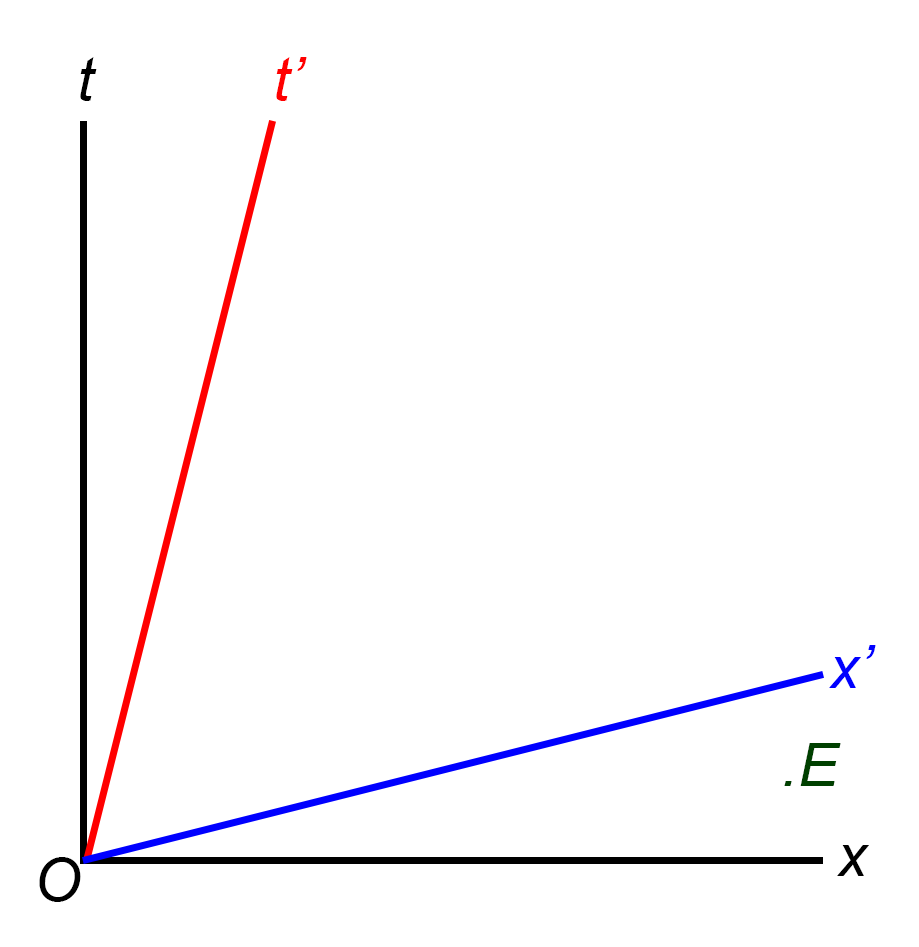 Point O represents the location of two observers A and B at the present time. The vertical axis (t) represents time and the horizontal axis (x) represents one dimension of space for observer A. The x-axis also represents the present time according to observer A (all points where t=0). That is, it represents all points in (one dimension of) space at the current time. Points above the x-axis represent times in A’s future, whereas points below the x-axis represent times in A’s past.
If observer B is moving at high speed in the positive x direction, then the Lorentz equations inform us that his x’ and t’ coordinates for any event will generally differ from observer A’s coordinates. We use the primed notation (‘) to indicates coordinates for observer B. Notice that observer B’s time axis (shown in red) is tilted relative to observer A’s time axis. Therefore, what observer B sees as a stationary object (moving only forward in time but not moving in space), observer A will see as moving through both time and space. This includes observer B himself who is stationary relative to his own imposed coordinates, but who is moving relative to A.
Likewise, observer B’s x’-axis is tilted relative to observer A’s x-axis. Therefore, if observer A sees two events separated only in space but happening at the same time, observer B will see the events as happening at two different times. This is a way of visualizing the relativity of simultaneity. This is why Dennis’ view (that time is not a dimension and is independent of the three spatial dimensions) is incompatible with the physics of Einstein. Time is not fully independent of the spatial dimensions because what one observer experiences as space only will be experienced by another observer as a combination of space and time. This follows inescapably from the Lorentz transformations as derived in chapter 8 of The Physics of Einstein (Lisle 2018).
Here is where things get really interesting. Notice that the present according to observer A is all points where t = 0. So, the present is represented by the (black) x-axis. However, according to observer B, the present is all points where t’ = 0. So, the present (according to observer B) is the (red) x’-axis. According to the philosophy of presentism, “only present things exist.” Thus, the only events that could actually exist would be found along the (black) x-axis according to observer A. However, according to observer B, the (red) x’-axis is the actual present. Therefore, if presentism were true, only the points along the (red) x’-axis could exist. But these are not the same as the points along the (black) x-axis!
Observers A and B have different presents if the one-way speed of light is exactly c for each of them as stipulated in ESC. Therefore, if presentism is true, and if ESC is the correct convention for each observer (as Dennis affirms), then the only events that can exist are those found along both the (black) x-axis, and the (red) x’-axis. But these intersect at only one point. In other words, if presentism were true then the only point that could exist is point O – which represents the current location at the current time. Therefore, if “only present things exist,” then it must also be the case that “only here things exist.” Putting it another way, if the only time that can exist is now, then the only location that can exist is here. If would follow logically that distant locations are not real despite the fact that we can see them.
So, if time is not a real dimension (as Dennis asserts), if the universe is not four-dimensional, then it is zero-dimensional! This is because the three dimensions of space are not independent of the dimension of time. They are intricately linked into a four-dimensional reality we call spacetime. If there is no time dimension, then there can be no spatial dimensions either – if the physics of Einstein is basically correct. This is why Dennis’s denial of the existence of an actual spacetime is incompatible with known physics.
The Andromeda Paradox
As an interesting aside, the ESC convention leads to an intriguing puzzle known as the Andromeda Paradox. When we define “now” by stipulating that the one-way speed of light is the same in all directions for any given observer (ESC), the present (“now”) of one observer will necessarily be different from the present (“now”) of another observer in relative motion. This is again represented by the different (black) x-axis and (red) x’-axis. Thus, an event E in the above diagram would be in the past according to observer B’s coordinates (it is below his x’-axis), but would be in the future according to observer A’s coordinates (it is above his x-axis). This effect is very small for the kinds of speeds and distances we normally experience on earth, but becomes very large at cosmic distances.
Suppose two people pass each other on the sidewalk. On that particular time of day, the earth is positioned such that one person happens to be walking toward the Andromeda Galaxy, while the other person is walking away from it. Suppose a person sitting on a bench right next to them is reading a newspaper. At the exact moment they pass, a fleet of spaceships launches from the Andromeda Galaxy on its way to earth.[3] Using the coordinates of the man walking toward the Andromeda Galaxy, the fleet already launched several days ago. The event is in his past. However, using the coordinates of the man walking away from the Andromeda Galaxy, the event has not happened yet and is several days in his future! This can be proved using the Lorentz transformations, and is visualized in the above Minkowski diagram.
The paradox is resolved by recognizing that each observer has stipulated the one-way speed of light as c relative to himself, and therefore has a different definition of “now” from the other two observers. And since the one-way speed of light is not an objective property of nature, but a humanly stipulated convention, there is no objectively unique “now” and therefore no genuine contradiction. (However, if ESC were not merely a convention but a necessary reality as Dennis has been arguing, then the Andromeda Paradox would be a genuine contradiction.)
The objective reality is the spacetime interval between the event of the two men passing and the launching of the fleet. How that spacetime interval is interpreted in terms of its temporal and spatial components by each observer depends on his state of motion and his chosen synchrony convention. (Incidentally, the ASC convention does not suffer from this paradox as long as all observers are on or near earth.)
Rescuing Devices
We have seen that “the present” is not objectively independent of motion, but depends on the state of motion of the observer and his chosen synchrony convention. Thus, what is present for one observer will be future or past for another observer. Therefore, the notion that “only present things exist” is false.
Let us anticipate a possible way that a presentist might try to escape this dilemma. One option would be to reject the physics of Einstein. But this branch of physics has been so well tested that it is unrealistic to argue that it is simply false. Indeed, hundreds of experiments have verified the accuracy of the predictions of Einstein to exceptionally high precision.
There are several philosophical interpretations of the physics of Einstein that embrace the mathematics while denying the normal interpretation thereof. One such attempt might be to argue that there is only one “real” reference frame, and that all others are artificial. In this view, only one observer’s present can actually be the real one. People who believe that the earth doesn’t move will sometimes appeal to this interpretation. They might say that the earth is stationary relative to some undetectable ether and that all other objects are in motion relative to it.
Likewise, one might assert that there is only one actual, legitimate reference frame which may or may not be detectable, marking what is actually stationary and reflecting the true flow of time. All other reference frames are “artificial” in that they do not reflect the actual spatial dimensions nor the true flow of time. Thus, while moving clocks tick slow (for whatever reason), they do not reflect the true passage of time which is marked by clocks that are stationary relative to some as-yet-undetected ether.[4]
One problem (of many) with this view is that there is no way to know what the “true” reference frame is. Is it the earth that is stationary relative to some undetectable either? Is it the sun, the galaxy, or the average mass of the universe? And why? Any choice is ultimately arbitrary since the laws of physics work equally well for any internal frame. When solving cosmic solutions to Einstein’s equations in general relativity, we often use the theoretical average momentum of the universe as a convenient reference frame. But this is not a necessary requirement. Furthermore (1) we really have no way of knowing what the average momentum is,[5] and (2) why should that be the reference frame? What if the average momentum of the universe is moving at ¾c relative to the “true” reference frame? We would have no way of knowing.
Second, the equations of the physics of Einstein are symmetric. If observer A sees observer B’s clocks running slow due to relative motion, then observer B will see observer A’s clock running slow by exactly the same amount. There is not the slightest hint that one of the two frames is somehow special. The physics of Einstein does not prefer one reference frame over another, providing both are inertial. So, even if there were a privileged reference frame, the physics of Einstein predicts that it will be impossible to ever discover it. It therefore seems absurd to arbitrarily declare some undetectable reference frame as marking the true state of space and time.
Third, Dennis cannot rationally embrace this view anyway since it is inconsistent with the Einstein synchrony convention which he has defended as the only possible convention. That is, if only one reference frame is “true” then the one-way speed of light could be c in all directions only as measured by that one frame. In all other frames, the one-way speed of light would be objectively non-isotropic relative to the moving observer. But Dennis has claimed that the one-way speed of light must be c – without specifying which reference frame. Thus, this position would be inconsistent with his position. In fact, the Lorentz equations allow us to convert from the ESC coordinates of observer A to the ESC coordinates of observer B without preferring one over the other. The epsilon-Lorentz equations allow us to do the same for any synchrony convention.
Conclusion
In this final article on presentism, we have seen that such a philosophy is incompatible with the physics of Einstein. Physics deals with real time intervals that cannot exist if “only present things exist.” Furthermore, the physics of Einstein shows that spacetime is real: that space and time are not independent dimensions but rather facets of a four-dimensional spacetime. In the next article, we will examine some of Dennis’s other errors in physics.
References
Dennis, P. 2024. An internal contradiction of Lisle’s Anisotropic Synchrony Convention (ASC) model. Answers Research Journal 17: 427-433
Lisle, J. 2018. The Physics of Einstein. Aledo, Texas: Biblical Science Institute.
Lisle, J. 2024. A Refutation of Phillip Dennis’s Claims Regarding Alleged Inconsistencies in ASC. Biblical Science Institute, Jul 13.
[1] We have every reason to trust that the physics of Einstein is basically correct. It has passed every experimental test that has ever been conducted. We recognize that the incompatibility of relativity and quantum mechanics suggests a more sophisticated model that encompasses both.
[2] One of the things I demonstrated in my 2010 paper on this topic is that neither observer is objectively right or objectively wrong. Any event between the past and future light cones can be considered simultaneous with an observer depending on the state of motion of the observer and the chosen synchrony convention.
[3] Lest Dennis try to misrepresent me again as he did with my discussions of time travel, let me state for the record that I do not believe that there are extraterrestrials living in the Andromeda Galaxy (or anywhere) or that such a fleet is actually on its way. This is a purely hypothetical illustration designed to showcase the relativity of simultaneity under the Einstein synchrony convention.
[4] The notion of separating the ticking of clocks with the passage of time is somewhat contrived. After all, what do clocks measure if no the passage of time? This is particularly the case when all clocks of any possible construction are affected by time dilation.
[5] Some astrophysicists assume that the cosmic microwave background (CMB) marks the average momentum of all mass in the (visible) universe. But this (1) assumes the big bang which is false, (2) could only mark the average momentum of mass in the visible universe which may be only a small part (and thus not reflective) of the mass of the entire universe, and (3) cannot be exactly the average momentum even in the visible universe due to inherent fluctuations of temperature. Regarding the third point, the CMB has an internal dipole moment that cannot be distinguished from doppler motion.